Juxtaposed
By Andrea Lingle
‘You have heard that it was said, “You shall love your neighbour and hate your enemy.” But I say to you, Love your enemies and pray for those who persecute you, so that you may be children of your Father in heaven; for he makes his sun rise on the evil and on the good, and sends rain on the righteous and on the unrighteous…Be perfect, therefore, as your heavenly Father is perfect. Matthew 5:43–45, 48
What is perfection? An early spring blue sky, a cool breeze in warm shade, a cherry blossom?
When we think of what is perfect, of what is holy, there is more than a slight risk of measuring it by its approximation of and proximity to the ideal. The unblemished landscape, physique, or conscience, can be the plumb-line by which one marks one’s deviation from perfection. We chase the illusion of perfection with the relentlessness of those who might achieve it while, in actuality, we stand in front of an overboiled radiator three postal codes away. The placid mountain lake reflecting the perfectly slow walk of the gentle mystic whose very shadow is a panacea lies just beyond the real, where you are, struggling to control your rage over a stolen parking spot in the lot of a big-box store, with next week’s frown-lines crowding out today’s worry lines.
The mandate to be perfect, as the Father in Heaven is perfect, feels as impossible as braiding moonbeams or improving the sound of a sleeping infant. Even the pursuit of holiness is rife with the pitfalls of self-righteousness and pride. Merton writes in Life and Holiness of those who call themselves saintly, “His words are always the most edifying clichés, fitting the situation with a devastating obviousness that silences even the thought of dialogue.” Those who call themselves saints leave no room for even the whisper of another’s opinion. “Sanctity is indeed a cult of the absolute.” (Merton, Life and Holiness, p 23)
So then, in the search to be part of the holiness of the world, what constitutes a step in the right direction?
How can I attain eternal life? Which is the most important commandment? Who is my neighbor? What must I do to be saved?
And Jesus said, “Sell everything. Love. The broken. Be born again.” What kind of answers are those? You must start over so that you can see that to love the world is what is holy. To do this, you only have to take on the mind of a child. This is not a certain population. Jesus said to stand like a servant at the door who has no idea when the master will return.
Watch. Attend.
Holiness, sanctity, has very little, indeed, to do with certainty.
But, what is holiness if not certainty?
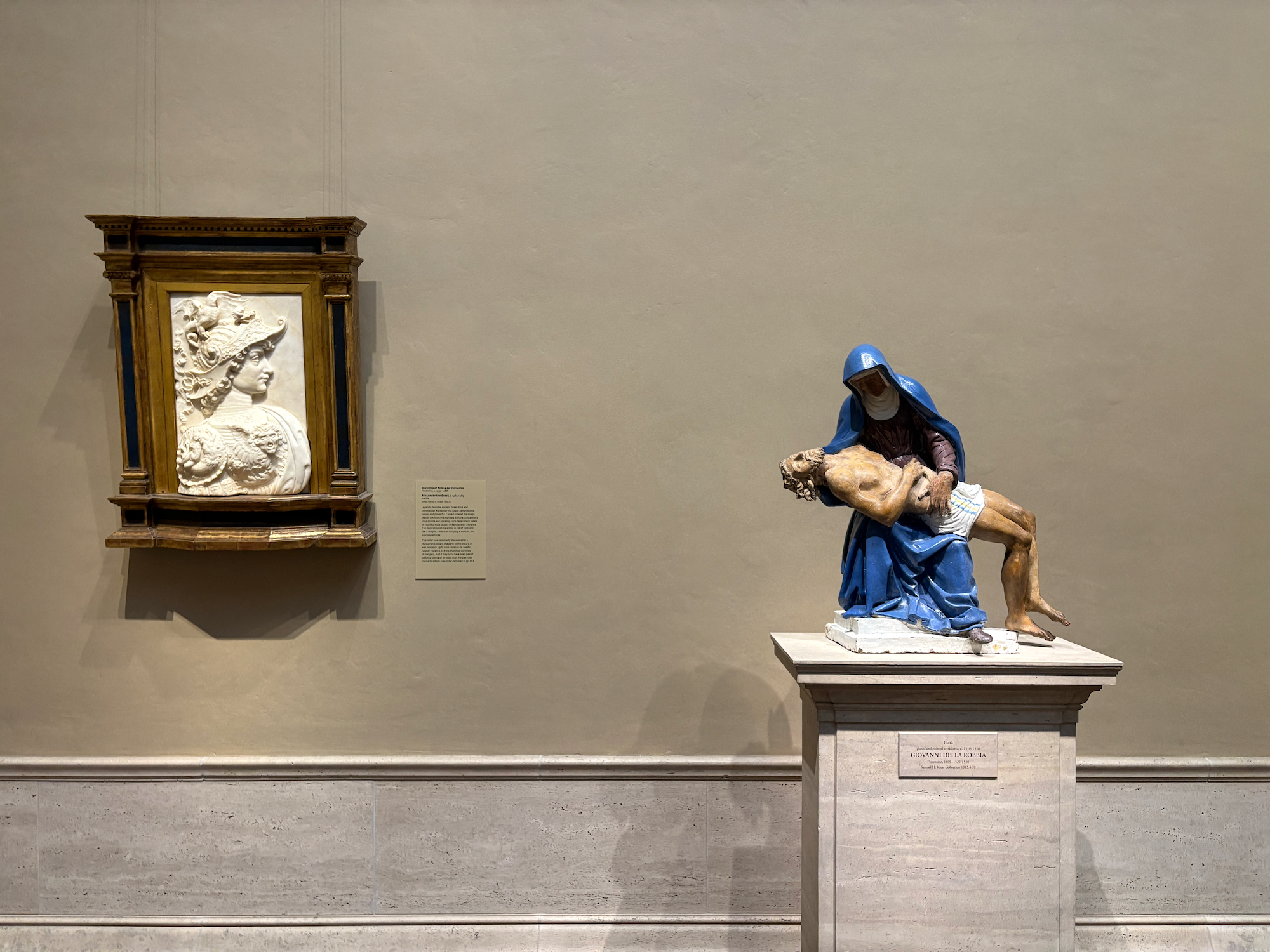
Holiness is not captured by the ideal forms, as satisfying as that would be, it is the wild juxtaposition of Alexander the Great and the Pietà (pictured above). I wandered past this pairing at the National Gallery this week and stumbled to a stop. Was this intentional? Did some art history theologian place these two images in tension to stagger the soul? Was this irony? Accident? Perfection in the Grecian Hero next to the brokenness of the sorrowful mother? This was not some beautifully rendered Pieta. Mary’s face was chipped and eroded to a obscure mask. Jesus’s broken body mottled and weak. Alexander’s face was smooth and alabaster. His adornment ornate, opulent, and triumphant. This is the ideal man. The face of perfection.
I wanted to, self-righteously, scoff at the haughty perfection of the marble conquerer, and piously embrace the humble perfection of the Pietà, but I had just walked passed a half thousand gilded Jesuses worked in the richest pigments taken from the walls of a half thousand glorious churches, painted by the most gifted artists of every time. I and the church have not exactly understood the perfection of the Pietà. Exceptionalism and heroism have been embraced as thoroughly by the church as by the Greeks. Perhaps this keeps the concept of sanctity or holiness just enough removed that we don’t have to actually pursue it.
And this might keep us safe If perfect behavior were the mandate. But it isn’t. Love is. Perfect love is not strength or power or even certainty. It is being born again to wonder, to awe, to knowing nothing. It is being willing to see and unwilling to trample. Perfection is the Pietà.
If you feel inclined, comment with one word or one sentence that answers: Where do you see power and perfection juxtaposed?